|
©The Archaeological Settlements of Turkey - TAY Project
|
|
|
|
|
|
Trapezopolis |
|
|
For site maps and drawings please click on the picture... 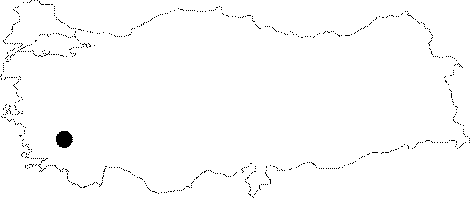 |
For photographs please click on the photo...  |
|
Type:
|
City |
|
Altitude:
|
m |
|
Region:
|
Aegean |
|
Province:
|
Denizli |
|
District:
|
Babadag |
|
Village:
|
Bekirler |
|
Investigation Method:
|
Survey |
|
Period:
|
Roman |
|
|
|
  |
|
| Location: It is located near the Bekirler Village; to the northeast of the Babadag District of the Denizli Province [Simsek 2002:3-4]. |
| Geography and Environment: The city located on the northern slopes of Salbacus (Babadag) overlooks the Lycos plain. It is a known fact that many of the cities located in this valley were involved in textile trading; which was also probably true for Trapezopolis. The administration borders extend to the Meander River to the north; Attouda to the northwest; and Laodiceia to the east. The city is located at the Carian and Phrygian border. |
| History: The city was founded in the 2nd century BC. She struck coins during the Augustus Period; and included in the Alabanda Conventus [Plinius 5; 109]. |
| Research and Excavation: It takes place in the registered archaeological sites list prepared by Ministry of Culture and Tourism. |
| Stratigraphy: |
| Small Finds: |
| Remains: Cistern: There is a cistern of a lime mortar masonry erected by rubble stones and re-used material on the same plain ground with the city. It is steeple crowned; with a cylindirical section [Simsek 2002:4]. Necropolis/Graves: The burials are distributed on the slopes around the city and at where the Bekirler Village is located. There are necropolises mainly to the south; and north and east of the ancient city. There are five types of burials. The first type consist of basins with a basic masonry for less fortunate people. The second type is with a cylindrical terra cotta sarcophagus placed into a basin; sealed with a flat stone closure. The dead lies in the sarcophagus as inhumation. The grave gifts were found inside and outside the sarcophagus. It seems that this type of graves were common from the 2nd century BC until the end of the Roman Period [Simsek 2002:5]. The marble girlanded sarcophagus is the third type. It is decorated with Nike; Eros; garland; bunch of grapes and round bust-rosette figures. It might have been constructed by the School of Aphrodisias in the 3rd century AD. Inside the burial houses which are the fourth type; the klines were placed on three sides of the burial chamber. The two graves that were found do not yield much data due to their conditions. The researcher reports that similar graves are seen in the Lycos Valley with plain roofs; and they were common during the 2nd-3rd century AD. The fifth type of burials are the most common type of vaulted graves; very typical of Trapezopolis and Attouda; which provide information about the economic status of the city with their monumental architechure. Reflecting the family burial customs; they were built for the wealthy and aristocratic persons [Simsek 2002:7]. The 52 vaulted graves that were unearthed consist of a front and a rear chamber; generally constructed according to the topography; using local flat greenish rubble stones; tiles; and lime mortar. There are usually niches on three sides of the rear chambers; where the grave presents were placed. Some vaulted graves containing cylindrical terra cotta sarcophagi indicate inhumation. The main entrances have rectangular doors. Usually there are three rectangular niches for presents accross the burial room and on both sides. This type of vaulted graves are also common in Anatolia during the Roman Period. Similar examples of vaulted graves are observed in Mylasa; Alagun; Kaziklibucak; Euromos; Hydisos and Bargylia as well. The vaulted graves consisting of a front and a rear burial room in Trapezopolis are different compared to a single room with adjacent rooms; front entrance; double story; and front courtyard of the Carian vaulted graves. |
| Interpretation and Dating: |

